How CDN works with OTT
In 2026, the demand for live content—from professional sports to global church services—has reached a fever pitch. At the heart of this “Live Revolution” is the Content Delivery Network (CDN), a sophisticated architecture of distributed servers that ensures a viewer in London and a viewer in Tokyo can watch the same event simultaneously with minimal delay.
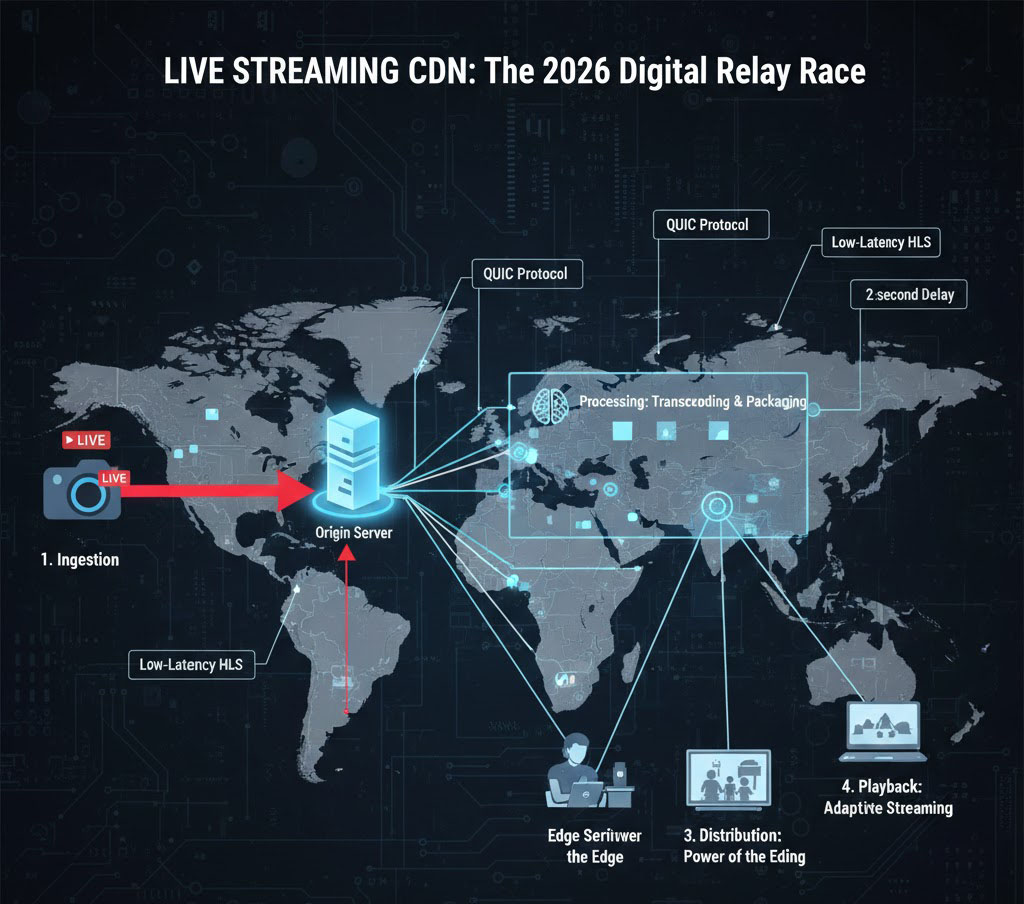
To understand how a CDN works for live streaming, it is best to view it as a high-speed relay race consisting of four critical stages: Ingestion, Processing, Distribution, and Playback.
1. Ingestion: The Digital Handshake
The process begins at the source, where the live event is captured. The raw video is encoded into a digital format (like RTMP) and sent to an Origin Server. In a world without a CDN, every single viewer would try to pull data directly from this one server. If 100,000 people tuned in at once, the origin server would experience a “digital heart attack” and crash.
Instead, the CDN “ingests” this stream. It acts as a shield, taking the single stream from the origin and preparing to replicate it millions of times over.
2. Processing: Transcoding and Packaging
Once the CDN has the stream, it must make it “viewable” for everyone. Not every viewer has a 5G connection; some are on spotty public Wi-Fi. The CDN performs Transcoding, creating multiple versions of the stream at different quality levels (e.g., 4K, 1080p, and 720p).
It then uses protocols like HLS (HTTP Live Streaming) or DASH to break the video into small, 2-to-6-second “segments” or chunks. These segments are the secret to smooth delivery, as they are much easier to move through the internet than one giant, continuous file.
3. Distribution: The Power of the Edge
This is where the “Network” in CDN comes alive. The CDN sends these small video segments to thousands of Edge Servers (also called Points of Presence or PoPs) scattered across the globe.
By 2026, many CDNs have integrated Edge Computing. This means the servers don’t just store data; they process it locally. When a user in North Carolina clicks “Play,” their request doesn’t travel to a data center in California. Instead, it hits an Edge Server in a nearby city like Charlotte or Raleigh. This reduces the “Round Trip Time” (RTT), effectively killing the lag that causes spoilers during live sports.
4. Playback: Adaptive Bitrate Streaming
The final stage happens on the user’s device. As the video segments arrive, the player uses Adaptive Bitrate Streaming (ABR). If the user’s internet speed dips, the player automatically requests a lower-quality segment from the Edge Server to prevent the dreaded buffering wheel.
Pro Tip: In 2026, the rise of QUIC (a faster transport protocol) and Low-Latency HLS has brought live stream delays down to under two seconds, making the “digital” experience nearly as fast as traditional cable TV.